

TABS
In this section, guitar, bass, ukulele, banjo & mandolin exercises in tablature form are offered to you free of charge. They will allow you to practice different techniques explained below.
All explanations are written for right-handers. For left-handers, reverse the order of the hands. The images used represent a guitar tab. If your instrument has fewer strings the principle remains the same except that you will see fewer strings on the tablature.
Do you like our free tablatures? Encourage us by clicking like and sharing our Facebook page or Youtube channel.


THE GUITAR BIBLE
200 pages of guitar tablature, exercises, songs, and explanations of soloing and rhythm guitar techniques. 1,000 guitar chords in all keys. Improvisation, composition, rhythms, musical notes, and music theory.
The book includes pages for chords, tablature, and blank musical staves for your compositions.
Everything you need to play all musical styles: rock, blues, folk, country, jazz, heavy metal, classical…
Download in electronic format.
12,99 $
Available in paperback format. Qualifies for free shipping.
31,95 $

BOOK TECHNIQUES AND TABLATURES FOR GUITAR VOL. 1
NEW EDITION
The book of techniques and tablatures for guitar volume 1 is 45 pages of explanations of the different techniques of the guitar (hammer-on, pull-off, tapping, slide...) and new exercises, in the form of guitar tablatures, practicing different musical styles such as: blues, rock, flamenco, classical, folk, metal ...
The book includes a blank tablature sheet for your compositions.
Download in electronic format.
5,99 $
Available in paperback format. Qualifies for free shipping.
15,99 $

BOOK TECHNIQUES AND TABLATURES FOR BASS VOL. 1
NEW EDITION
The book of techniques and tablatures for bass volume 1 is 44 pages of explanations of the different techniques of bass (hammer-on, pull-off, tapping, slap...) and unpublished exercises, in the form of tablatures, practicing different musical styles such as: blues, rock, flamenco, classical, folk, metal ...
The book includes a blank tablature sheet for your compositions.
Download in electronic format.
5,99 $
Available in paperback format. Qualifies for free shipping.
15,99 $

TAB
The bottom line represents the big string and the top line the little string. The numbers on the lines represent the frets to be played. Use these tablature sheets to write your songs.

FINGERPICKING
Play with the fingers of the right hand instead of the pick. "P" = Thumb, "I" = Index, "M" = Middle, "A" = Ring.

PICK STROKE
Play a pick down move is identified by the left sign and play a pick up move is identified by the right sign.

SWEEP PICKING
Leave the pick against the next rope. Technique for the speed of the pick.

SLIDE
Give a pick stroke to the first fret, slide and give a pick stroke to the second fret.

LEGATO SLIDE
Slide your finger on the handle from one fret to another, without removing the pressure to hear the sound of the slide.

STACCATO
Play each note detached, with a pause between each note. It is identified by a point above or below the note.

SLIDE UP AND DOWN
Give a pick stroke on a lower fret and slide to the indicated fret or give a pick stroke on the indicated fret and slide towards a lower fret.

SLIDE DOWN AND UP
Give a pick stroke on a higher fret and slide to the indicated fret or give a pick stroke on the indicated fret and slide to a higher fret.
SUBSCRIBE TO OUR PATREON FOR MORE TAB, CHORD, MP3, VIDEO TUTORIALS AND GUITAR PRO
Content available for download for learning in the comfort of your home. Summaries of popular songs of all genres. Technique and chord books. Technical exercises and music theory...
Price
6$ / month
Deep Purple
Metallica
Eagles
AC/DC
Artic Monkeys
Johnny Cash
Michael Jackson
Leonard Cohen
Israel Kamakawiwo'ole
Ben E. King
Black Sabbath
Nirvana
Pink Floyd
The Cranberries


HAMMER-ON
Play the first note with the pick and hit the second note with the finger. It is identified by a link between ascending notes (frets).

PULL-OFF
Place all the fingers of the left hand in their respective places. Play the first note with the pick and pull the string with your finger. It is identified by a link between descending notes (frets).
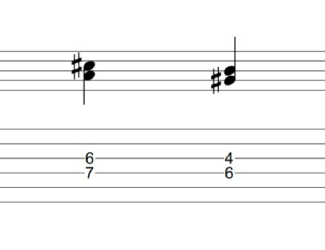
THIRD
Use fingers 1 and 2 for the frets next to each other and fingers 1 and 3 for the distant frets.

POWER CHORD
Used in rock, blues and metal styles. We use fingers 1 and 3 for 2-note chords and fingers 1, 3 and 4 for 3-note chords.

ARPEGGIO
Play all the notes of a chord one after the other.
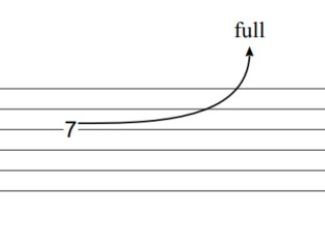
BEND
Gradually push up on the string to tension the string and raise the sound according to the number of tones indicated near the arrow. Full means a tone.
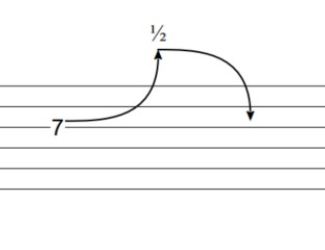
BEND AND RELEASE
Gradually push up on the string to tension the string and raise the sound according to the number of tones indicated near the arrow and return the string to the initial position.
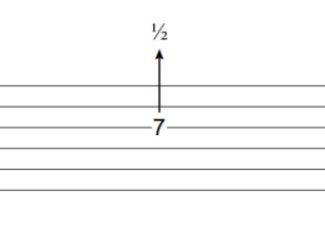
PRE-BEND
Stretch the string and raise the sound according to the number of tones indicated near the arrow. Then give your pick.
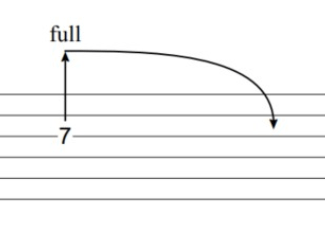
PRE-BEND AND RELEASE
Stretch the string and raise the sound according to the number of tones indicated near the arrow. Then hit your pick and return the string to the initial position.
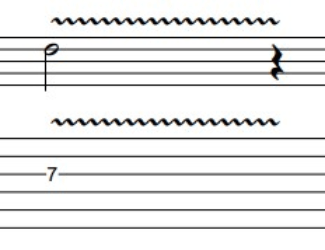
VIBRATO
Go up and down the string quickly to make it vibrate. It is identified by a wave above the tablature.
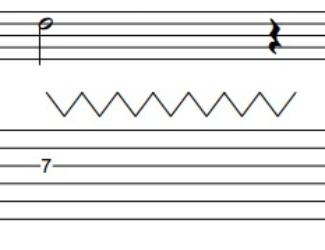
VIBRATO (wide)
Play the indicated note and move the string up and down significantly while keeping your finger pressed down to create a vibrato effect. This technique is marked by a zigzag symbol above the tablature and is often performed by raising and lowering the tremolo bar.

BOOK CHORDS AND NOTES FOR UKULELE THE ESSENTIAL
The book chords and notes for ukulele volume 1 is 31 pages of explanations of the ukulele chords: major, minor, maj7, m7, m7b5, dim7, sus2, sus4,, 7sus4, m6, 6, 9, m9, dim, aug ... (in all tones), the notes on the neck in 1st and 5th position, the rhythmic values in 4 and 8 and the explanation of the principle of the chords.
The book includes blank chord sheets and musical staves for your compositions.
Download in electronic format.
5,99 $
Available in paperback format. Qualifies for free shipping.
15,99 $

BOOK CHORDS AND NOTES FOR GUITAR THE ESSENTIAL
The book chords and notes for guitar volume 1 is 33 pages of explanations of the guitar chords: major, minor, maj7, m7, m7b5, dim7, sus2, sus4, 7sus2, 7sus4, 5, 6, 9, 13, 7 # 9, 7b9 ... (in all tones), the notes on the fret in 1st and 5th position, the rhythmic values in 4 and 8 and the explanation of the principle of barred chords.
The book includes blank chord sheets and musical staves for your compositions.
Download in electronic format.
5,99 $
Available in paperback format. Qualifies for free shipping.
15,99 $
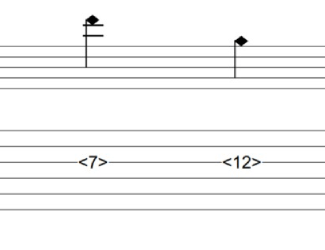
NATURAL HARMONIC
Place a finger of your left hand above the fret wire without pressing and play the string normally with the pick to produce a crystal clear sound. It can be identified by "N.H." above the note or be framed by: « < > ».
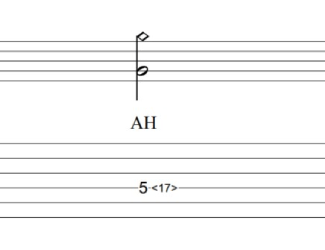
ARTIFICIAL HARMONIC
Place a finger with your left hand 12 boxes less than the number indicated. Lean, without pressing, the index finger of the right hand above the indicated fret wire and play the string with the ring finger of the right hand. It is identified by an A.H. above the note.
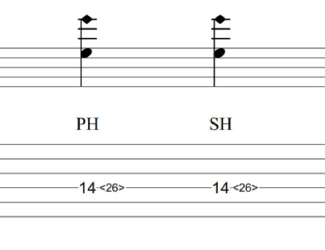
PINCH HARMONIC
Place a finger of your left hand on the indicated fret. Hold the pick firmly, leaving only a few millimeters exposed at the tip. Rotate your right wrist slightly so that your thumb touches the string immediately after the pick, aligned with the fret wire of the fret indicated between the < > symbols. This technique is marked as "P.H." above the note. A semi-harmonic ("S.H.") uses the same technique but allows a portion of the fundamental note to be heard as well.
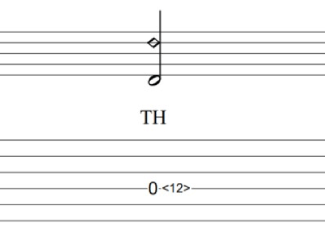
TAP HARMONIC
Place a finger of your left hand on the indicated fret. With your right hand, strike directly on the fret indicated between the < > symbols.
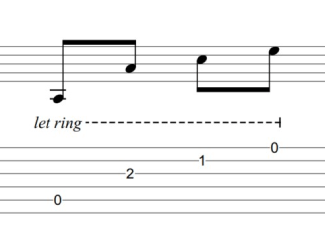
LET RING
Keep your fingers in place to let the notes resonate for as long as possible.

DEAD NOTE
Release the pressure from the finger on the fretboard while keeping it in contact with the string to mute the note. This is indicated by an "x".

PALM MUTE
Place the palm of your right hand on the strings, near the bridge, to reduce the resonance of the strings. It is identified by “P.M.” with a dotted line which shows the beginning and the end of the notes to be attenuated.

TREMOLO PICKING
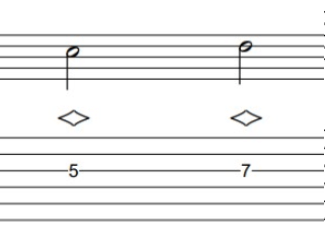
Play with the pick down and up as quickly as possible. It is identified by 3 italic lines superimposed above or below the note.

FINGERPICKING TREMOLO
Play the bass with your thumb first, then play the ring finger, middle finger and index finger on the same string. All as quickly as possible.
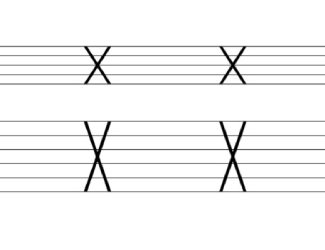
PERCUSSIVE TONE (dead slapped)
Often used on the acoustic guitar, this technique involves striking the strings with the side of the right hand to imitate percussion. One can also tap on the wood of the instrument with the fingertips at the same time.
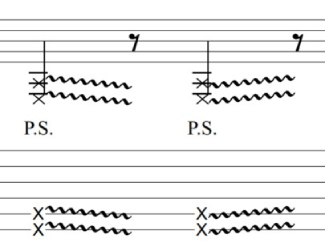
PICK SCRAPES
Scrape the thick, ribbed strings using the side of the pick. If the line on the page goes downward, scrape toward the lower-pitched notes; if it goes upward, scrape toward the higher-pitched notes.
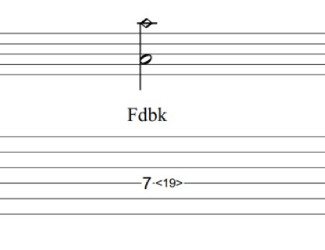
FEEDBACK
Play a note facing your amplifier, using high volume and high-gain distortion to make the note scream. Using artificial harmonics helps achieve this effect more quickly.
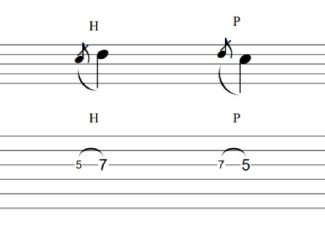
GRACE NOTE (before the beat)
Play the first small highlighted note very quickly, using a hammer-on or a pull-off so that the second note lands on the beat.
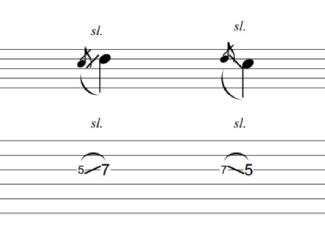
GRACE NOTE (slide before the beat)
Play the first small, highlighted note very quickly, using a slide so that the second note lands on the beat.
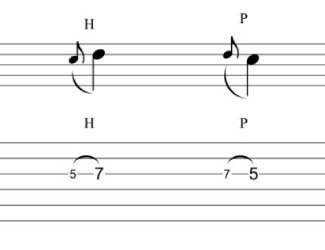
GRACE NOTE (on beat)
Play the first small note very quickly on the beat, using a hammer-on or pull-off so that the second note occurs after the beat.
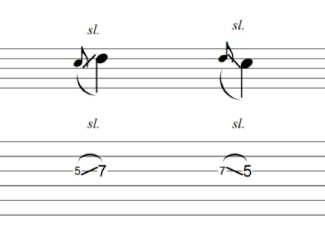
GRACE NOTE (slide on beat)
Play the first, short grace note very quickly on the beat, using a slide so that the second note arrives after the beat.
VOLUME SWELL
Close the volume pedal (or knob), play the note, and gradually increase the volume. You can also do the reverse. Certain automated effects allow you to achieve the same result without using a volume pedal.
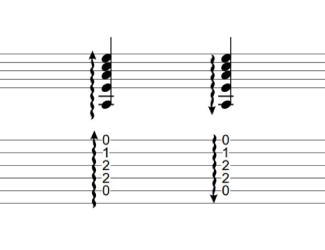
BRUSH
Gently sweep across the strings one by one, in a controlled manner. This can be done using a pick or by fingerpicking. If the arrow points upward, sweep from the thickest string to the thinnest string; if the arrow points downward, sweep from the thinnest string to the thickest string.

ELECTRONIC BOOK BASIC UKULELE CHORDS AND NOTES
NEW EDITION
The e-book basic ukulele chords and notes is 14 pages of explanations of guitar chords: major, minor, maj7, m7, m7b5 (in all keys), the notes on the neck, the notes in first position and the rhythmic values in 4.
The book includes blank chord sheets and musical staves for your compositions.
2,99 $

ELECTRONIC BOOK BASIC PIANO CHORDS AND NOTES
NEW EDITION
The e-book basic piano chords and notes is 12 pages of explanations of piano chords: major, minor, maj7, m7, m7b5 (in all keys), the notes on the keyboard and the rhythmic values in 4.
The book includes blank chord sheets and musical staves for your compositions.
2,99 $

ELECTRONIC BOOK BASIC GUITAR CHORDS AND NOTES
NEW EDITION
The e-book basic guitar chords and notes is 14 pages of explanations of guitar chords: major, minor, maj7, m7, m7b5 (in all keys), the notes on the neck, the notes in first position and the rhythmic values in 4.
The book includes blank chord sheets and musical staves for your compositions.
2,99 $
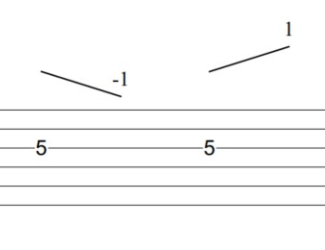
DIVE
Place a finger on the fret, strike the string with your pick, and gradually push the tremolo bar downward to lower the pitch by the number of tones indicated next to the line. Pull upward to raise the pitch. If the term "Hold" appears, you must sustain the note for the number of beats indicated.
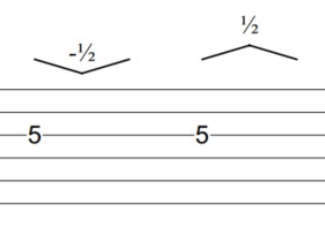
DIP
Place a finger on the fret, strike the string with the pick, and quickly push the tremolo bar downward to lower the pitch by the number of steps indicated near the line before returning it to the starting position. Pull upward to raise the pitch.
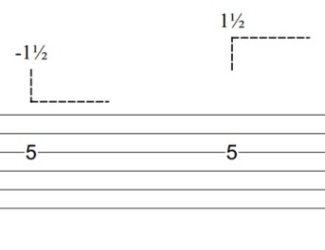
PREDIVE
Push the tremolo bar downward to lower the pitchby the number of steps (in the negative direction) indicated near the line before striking the string with the pick, and hold it in that position for the specified number of beats. Pull upward to raise the pitch.
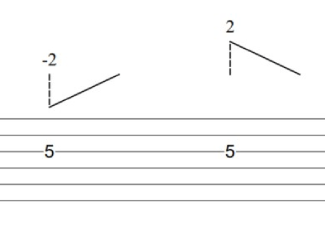
PREDIVE / DIVE
Push the tremolo bar downward to lower the pitch by the number of steps indicated near the line before striking the string with the pick, then gradually return the bar to its normal position. Pull upward to raise the pitch.
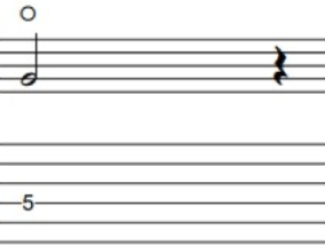
WAH (open)
Press down on the heel end of the wah-wah pedal to lift your toes. This will muffle the high-pitched notes. This effect is indicated by an "o" above the note.
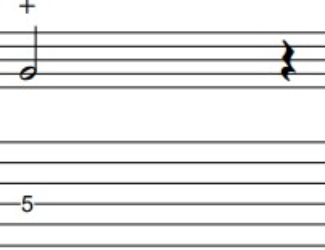
WAH (close)
Lower your toes so that the wah-wah pedal is in a horizontal position. This effect is indicated by a "+" above the note.
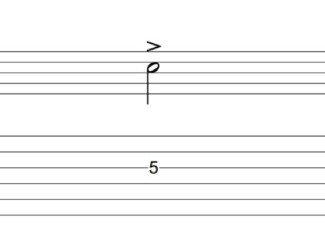
MARTELLATO
When the ">" sign appears above or below a note, it indicates that it should be played strongly.
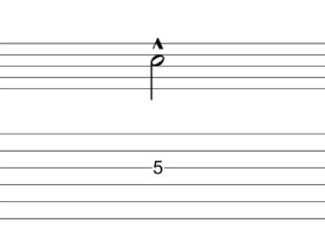
MARCATO
When the "^" symbol appears above or below a note, it indicates that it should be played VERY strongly.
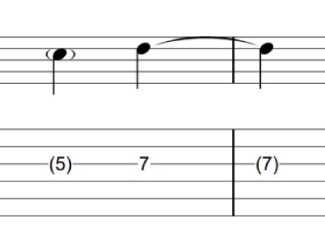
GHOST NOTE
A note in parentheses is played at a very low volume, as if the musician had not intended to play it. This should not be confused with the same note being tied across adjacent measures; in that case, the first note should be allowed to ring for the indicated number of beats, without re-playing the second note (which appears in parentheses).
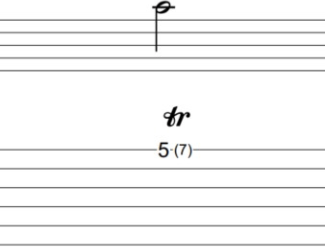
TRILL
A trill is a rapid, alternating sequence of hammer-ons and pull-offs between two notes, typically separated by one or two frets on the same string.

SLAP - POP
The slap is produced by striking the string with the side of the thumb of the right hand, it is identified by an "S" above or below the note. The pop is produced by pulling the string with the index or middle finger of the right hand, letting it fall so that it strikes the fret wires. It is identified by a “P” above or below the note.

DOUBLE THUMB
Use the thumb of your right hand as a pick. It is identified by a "D" above or below the note to play the string down and a "U" to play the string up.
CONTACT
You want to know more ? You can contact us using this form.
SEND
CONTACT ADDRESS
2560 Bastien boulevard
Quebec City, Canada
G2B 1B1
BY APPOINTMENT ONLY
581-985-4268
2560 Bastien boulevard
Quebec City, Canada
G2B 1B1
BY APPOINTMENT ONLY
581-985-4268